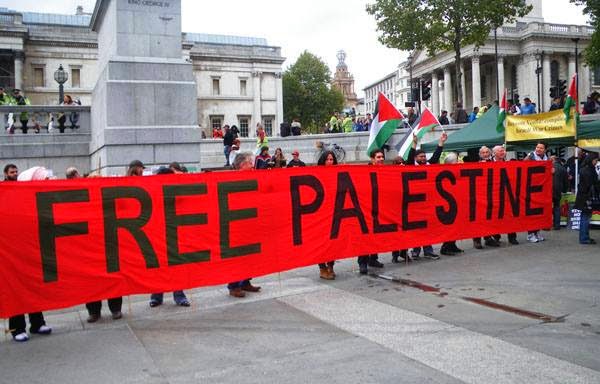
Free Palestine

Free Palestine

Saturday, November 17, 2012

HAMAS YATUNGUA NDEGE YA ISRAEL HUKO PALESTINA


Wanamapambano wa Palestina wametungua ndege ya kijeshi ya utawala wa Kizayuni wa Israel iliyokuwa inafanya mauaji dhidi ya wananchi wa Palestina.

Televisheni ya al Quds imezinukuu Brigedi za Izuddin Qassam, tawi la kijeshi la Harakati ya Mapambano ya Palestina HAMAS zikisema kuwa, ndege za utawala wa Kizayuni zimefanya mashambulizi makali katika eneo ilipoanguka ndege hiyo ya Israel ili kufuta ushahidi na kuwazuia wanamapambano wa Palestina wasipate mabaki ya ndege hiyo.

Vile vile wanamapambano wa Palestina wamefanikiwa kwa mara ya kwanza kushambulia maeneo ya Wazayuni katika mji wa Baytul Muqaddas na kuzusha kiwewe katika safu za utawala wa Kizayuni.

Kabla ya hapo pia HAMAS ilikuwa imetungua ndege ya Israel isiyo na rubani na ilishambulia pia Tel Aviv mji mkuu wa utawala wa Kizayuni na kuwalazimisha viongozi wa Israel wakimbilie mafichoni.

Televisheni ya al Quds imetangaza pia kuwa wanapambanao wa Palestina wamelishambulia kwa kombora bunge la utawala wa Kizayuni, Knesset, huko magharibi mwa Baytul Muqaddas. Taarifa zinasema pia kuwa hoteli za kitalii za Wazayuni zimefungwa huko Baytul Muqaddas baada ya maeneo yanayokaliwa kwa mabavu na Wazayuni ya mji huo kushambuliwa kwa makombora ya wanamapambano wa Palestina.

HUSSEIN (A): THE END OF A TRAGEDY OR THE BEGINNING OF AN UPRISING?


When certain seasons of worship come around like the months of Ramadan and Muharram, it is very important that we re-evaluate ourselves to see what blessings we have gotten from them. Were they in proportion with the power of the season? Have we preserved these blessings? How can we best invest these blessings after the season is over? Many people are pleased with the condition they have at the time, without worrying about what will come after the season. The Devil is eager to take away whatever the believer has earned at the first possible opportunity. Are we cautious about that? 

The movement of Imam Hussein (A) was a method for dealing with one’s own soul and with others, for he wanted to teach us a lesson about servitude at every stage of his blessed movement. We see him depart from the safety of the Divine Kaaba when he saw that it would please his Lord. We see him exposing his family to capture when he saw that his Lord willed for them to be captured. He exposed himself to the greatest forms of insult and torture when he saw that his Lord willed for him to be killed. His sister Zainab summarized all of these lessons when she confronted the oppressor of her era saying: I didn’t see anything but it was beautiful. God willed for this group of people to be killed, so they came out to be killed, and God will gather you and them together to be judged. So wait and see who will be victorious on that day!

The principle of dialogue through speaking is the well-known method of explaining the messages of the Prophets (A), and this is what was referred to when Almighty God said, {And each nation had its own warner.} But the corruption of the leadership sometimes reaches the point where warning and explanation are not sufficient to put an end to the greatest falsehood: the corruption of one who corrupts the entire nation by his actions – because the people follow the religion of their leaders. So it would be necessary to establish a movement beyond explanation and dialogue, an unusual movement in which blood is sacrificed. This movement would awaken the nation from its depths, to see the corruption of the leader’s soul after it had neglected the corruption of the leader’s deeds! And thus the rule of the Umayyads collapsed shortly after the killing of Hussein (A). His revolution was considered the source of all revolutions which arose throughout the nation which hadn’t been seen before the killing of Chief of Martyrs (A). 

We notice this year and every year the spread of the majlis of Imam Hussein (A) all over the world. This revives our sense of hope that there is still a heart beating in the body of this nation, a heart which draws its blood from the pure blood that was spilt at Kerbala. All of that is by the blessing of the commemoration of one of the Imams from the chain of the Holy Family of the Prophet (A), so how many more blessings would there be if the last in this chain were present? We can imagine how much the hearts which thirst for justice would welcome this Imam after they lost hope in all the theories which promised to bring human happiness. 

One of the lessons of Kerbala is connecting between the highest degree of chastity and the defense of the religion by whatever power the individual is given. Thus we see Zainab (A) who observed hijab and shyness like no one else. Ali (A) would even try to keep her shadow from the view of outsiders by extinguishing or turning down the lights when she was visiting the grave of her grandfather the Holy Prophet (S). However when it came time, she was the tongue speaking in the name of the sacred law even in the presence of the Imam of her time, Ali ibn al-Hussein al-Sajjad (A). There is a saying that Islam owes its existence to Muhammed but its preservation to Hussein. While this is correct, we could also say that the origin of the reform movement was Hussein, while its preservation belongs to Zainab. 

There is a great likeness between Ibrahim (A) the beloved friend of God and Hussein (A) the sacrifice of God. God made the hearts of the people incline towards both of them. What we notice amongst those who gather for the remembrance of Hussein (A) and establish his mourning is something truly amazing! Just as we see people who don’t follow the sacred law throughout the year attracted to perform the Hajj, we see the same group showing a loyalty towards Hussein (A) which is not in proportion to their nature. This shows us that there is divine control over the hearts, and it appears that the movement during these two seasons of Hajj and Muharram are an answer to the prayer of Ibrahim (A). The reason for loving the family of the Prophet (A) in their valley of martyrdom is no less than the reason for loving the family of Ibrahim (A) in their valley of barrenness! 

Whatever we have done during the days of Muharram is a divine lesson in which God tests us for the heat of love for Hussein (A). The Holy Prophet (S) made it one of the tests of true faith. At the same time it is a claim against us, because after we get these divine blessings the judgement against us is swifter than if we hadn’t participated in them. The one who receives these blessings is not like the one who does not, and the one who has knowledge is not like the one who is ignorant. Is it enough to emerge from this season with tears and crying without seeing an important change in our life?! 

One of the important lessons of Ashura is to beware of coming to a bad ending in our lives. Some of the companions of Ali (A) participated in killing Imam Hussein. There are many people like this in history who have been cursed by the Imams and who were once their companions! All of us have to beware of the hidden seeds of major corruption, especially in the area of our beliefs, as one of the signs of the end of time is mental corruption. Some of the causes of this are committing major sins, companionship with corrupt people, profiting from what is forbidden, taking the material world over religion, finding pleasure in the fancy words which the Devil distributes to his friends, as the Holy Qur’an says, {The devils inspire their followers to argue with you.} 

Source : www.duas.org

Friday, November 16, 2012

MUHARRAM, KERBALA & IMAM HUSSAIN (AS)

Muharram, Kerbala & Imam Hussain (as)

EVENT & PERSONALITIES

Imam Hussain was the grandson of the Holy Prophet Muhammad, through his daughter, Lady Fatima and son-in-law, Imam Ali, peace be upon them all. 

In less than half a day on the 10th of Muharram ( Ashura) in the year 680 A.D. (61 A.H.), on the hot desert sands of Karbala in Iraq, Imam Hussain(as), and 72 of his family members, friends and followers, including his 6 month old infant son, were martyred under most gruesome circumstances. These included His brother Hazrat Abbas (as) the standard bearer, His young 18 yr old son Ali Akber & his 4 year old daughter Sakina who died while in prison in Damascus. The Oppressive ruler; Yazid son of Mu'awiya son of Abu Sufiyan & his very large army of over 30,000 men, committed these heinous crimes against the small group which included the household of the Prophet. Lady Zainub (sister of Imam Hussain) also played a key role especially subsequent to the battle to inform people of the truth.


The group, including the six-month infant Ali Asgar, was without food and water for 3 days before their martyrdom. Ali Asgar was martyred thirsty in his father's arms when his tender throat was pierced by a three-pointed poisoned arrow, while his father implored the tyrants to allow water to the infant, after all his other companions were martyred at their hands.

Imam Hussain resolved to defend his thirsty entourage from the killer army’s onslaught, rather than submit to their forcible extraction of allegiance to a criminal despotic regime which used the name of Islam. He was going to stand to his principle to defend True Islam, even though he might be the last man standing with no support, no help.

The martyrs were beheaded & their heads were put on spears, while their corpses were trampled upon and left unburied. The ordeal did not stop at this as the women and children in the Imam's entourage were held captives and tortured while being led on an arduous journey to Damascus to be paraded and later imprisoned . The only male survivor was Imam Zainul Abideen (as) son of Imam Hussain (as) who was ill at that time, yet chained & repeatedly beaten. He subsequently wrote a 'Treatise on Rights' & a monumental prayer book called Sahifa Kamila ( see www.Duas.org)

In the history of Islam, al‑Husayn ibn 'Ali, the martyr of Karbala, wrote one of the most brilliant chapters; a chapter which still and after more than fourteen centuries, echoes in the minds and hearts of Muslims everywhere. It is remarked by a modern Muslim writer that 'With every Karbala Islam is renewed'.

Edward Gibbon (1737-1794) considered the greatest British historian of his time. Wrote “In a distant age and climate the tragic scene of the death of Hussein will awaken the sympathy of the coldest reader." [The Decline and Fall of the Roman Empire, London, 1911, volume 5, pp. 391-2] 

Each year during the first Islamic month of Moharram and upto 40 days (Arbaeen) thereafter, mourning sessions are held all over the world, wherein the trials and tribulations of these martyrs are recounted, mourned and lamented, while expounding the values and teachings upheld by them. These practices are an institution in themselves and are being continuously held for the past 14 centuries. 

The Martyrdom is unique and unparalleled in a number of ways, the most obvious of all being its sacrifices from - men, women and children of all age groups, every conceivable human relationship, rich and poor, noblemen and slaves, military commanders and commoners, and individuals coming from different specters of human society.

REASONS 

Imam Hussain(as), his family and friends sacrificed everything ( life ,wealth, family honor) that they had ,in their struggle against tyranny and despotism and for upholding the human values of truth, justice and liberty of thought, word and deed. Their struggle was aimed at the ultimate goal of awakening human beings of all times to uplift the human spirit beyond short-sighted materialistic pursuits, and establish a just and equitable order in society. 

Imam Hussain wrote a will and handed it over to his brother Muhammad Hanafiyyah. The will read, ‘’I have not risen against Yazid in order to create corruption or discord, nor to elevate myself in the eyes of the people, nor to oppress.’’ Innama kharajtu litalabil islahi fi ummati jaddi wa abi’’ I have only risen to rectify, to reform the affairs of the Ummah of my grandfather and of my father. ‘’Uridu ‘an aamura bil ma’ruf wa anha ‘anil munkar.’’ I want to invite people towards good and forbid them from evil.’’ 

Yazid the oppressive ruler openly indulged in sinful activities like drinking, womanizing, terrorizing /killing innocent people, making fun of scholars etc & yet claimed to be rightful successor /leader of Islam & the Muslim ummah. The silent majority scared and terrified by the overflowing military might and power, did nothing about this. 

Yazid demanded that Imam Hussain (as) pay allegiance (bay'aa) to him. When asked to give bay’aa to Yazid, Imam Hussain said, ‘’ We are the household of the prophet hood, the source of messengership, the descending place of the angels, through us Allah had begun showering His favours, whereas Yazid is a sinful person, a drunkard, the killer of innocent people and one who openly indulges in sinful acts. ‘Mithli la yubayi’u mithlah’. A person like me can never do bay’aa(pay allegiance) to a person like him (Yazid). I look upon death as but the felicity of martyrdom and I regard life among oppressors and transgressors as nothing but agony and torture. By God I will never give you my hand like a man who has been defeated; nor will I flee like a slave.’’

He rejected the rule of a man who was generally agreed not to have been fit to rule. In this sense he was a revolutionary, as indeed he is now regarded by contemporary writers.

EFFECTS 

The event is of great significance because of what this martyrdom meant for the religion of Islam in exposing the wrong and upholding the right through the sharp contrast between him and his followers on the one hand and his antagonists on the other.

Mahatma Gandhi in 1924 writing in ‘Young India’’ about the battle of Karbala said among other things ‘’ I wanted to know the best of the life of one who holds today an undisputed sway over the hearts of millions of mankind….the utter self-effacement of Hussain, his fearlessness, his absolute trust in God and in his own mission to save Islam.’’

The Martyrdom has also prompted a vast body of literature in a multitude of languages all over the world, a phenomenon that continues to this day. Outstanding examples of this are the elegies written by Mir Anis, one of which holds the world record for the longest verse for the past two centuries. 

The largest gathering on the face of the earth since time began now occurs in Karbala in Iraq on Arbaeen ( 20 safar) where over 10 million pilgrims visit the shrine. 

Imam Hussain embodied in himself magnificent qualities - wisdom, knowledge, leadership, patience, humility, forbearance and total submission to the Almighty, to name a few - and his life is a source of inspiration and a role model for all generations to condemn all forms of oppression & Injustice.


Source: www.duas.org
HUSSAIN, THE UNIVERSAL LEADER


It is in the very nature of great reformers that they belong to everybody, everywhere.
Hussain’s noble deed is so relevant to the entire human race that I am sure there is a far bigger audience waiting for him somewhere than the one he already has. All that is required is to draw people’s attention.

Contemporary society, irrespective of race and religion, would do well to have a closer look at the Hero of Kerbala as his message transcends the barriers of caste creed, race and religion. Advocates of human rights, sociologists, reformers, theologians, all included, will find “delightful wisdom, sweet instructions, and a meaning suited to their mind”, in his story. His message is certainly not an exclusive preserve of any particular group. It embraces the entire human race. It was not a power struggle. Hussain persistently and explicitly expounded;what matters to me is to “correct not conquer” – An affirmation that he would die in the firm belief that a despot’s idiosyncrasies could never be an effective instrument of religious policies.

Yazid became too big for his boots and assumed the characteristics of a despot who, almost as a condition of his position, made boastful and frivolous claims that he alone could lead the nation
Hussain was, however, committed to redeeming Islam and maintaining the faith intact.

He hoped that matters would improve and kept a low profile to preserve amity. He had a clear choice: stand aside and let Yazid act according to his whims; (and thus join in and implicitly justify his abominable escapades) or counter his devious bluster. Hussain had to decide: to take the situation in its stride as a price worth paying for the “status quo”; or view it as an ominous foretaste of the consequences of the extensive damage done by the far-reaching anti-Islamic activities of Yazid, the mammon of unrighteousness, whose lust for power prompted him to beat the nation into the mould he favoured. He and his profane crew conspired to scuttle the ship of Islam by worse than heinous deeds, violating the aims for which Islam was born.

Hussain had no desire to live under such a corrupt Caliph. He wanted to act as quietly and as “spontaneously” as possible so as to limit the possibilities of an open clash with the Caliph. But Yazid bargained hard. Hussain could not take his effervescent nonsense perpetually and did what was right.
If the moral standards of human behaviour were as high as they were in the person of Hussain the world would be a better place to live in, is the obvious inference. His incredible cool and superhuman moral courage to achieve his mission stirs our deepest emotions. His exemplary conduct, throughout, and adorable conscience tore Yazid’s monstrous designs to shreds.

The virtuous people will continue to do their duty to maintain righteousness in this world and in this they are entitled to universal recognition and support.

Hussain’s acceptance of persecution in the cause of humanity was most convincing and moving proof of God’s immanence in men. He was a man par excellence who maintained the highest standards set by the martyrs and heroes of all ages. With a courage that was more than human he managed to leave a message for the entire world, “Do not submit to exploitation, of any kind; maintain a tenacious grip on veracity; better die with honour than live in shame”. He surely deserves universal recognition. “He is an immortal heir of universal praise”. More than Fourteen hundred years have passed but the memory of that adorable hero, who resolutely faced the soul-searching trials and tribulations, has not diminished. On the contrary, it has grown in intensity.

Imbued with exemplary fortitude, moral fibre and aplomb, Hussain has emerged as the most revered and meritorious martyr the world has produced, who established the highest standards of excellence of which humanity prides itself.

Shaheed Murtadha Mutahhari

Source: IBNTV

HUSSEIN: SYMBOL OF LOVE AND SACRIFICE


It is usually thought that Islam views God as a heartless Ruler of the world, an angry Judge, and a wrathful Lord who is looking meticulously for a wrongdoer to punish them. For those who have thoughtfully read the Quran only once in their lifetime it is very easy to discard this view beyond any doubt.

However, for those who have not carefully read the Quran, or do not have the necessary means and knowledge to analyse its verses, there stands, in the living memory of the history, an episode which, very clearly, epitomizes the notion of love between the creator and the created, and the sacrifice and suffering that could be endured readily and contentedly by a human being for the sake of the beloved God.

This episode is the event in which Hussain, the grandson of the Prophet of Islam, offered not only his soul and his flesh to the Lord, but that of his sons, his nephews his cousins and his closest friends, and bore the grief of the foreseeable capture of his wife, his daughters and his sisters. This happened on the 10th day of Muharram in a land called Karbala in the year 682 AD.

As the grandson of the Prophet and someone who was very much adored by him, Hussain could have lived a very comfortable and well-heeled life after his grandfather, much honoured and revered by his contemporaries. However, he was devoted to the cause of the Lord, concerned about the guidance that was revealed to his grandfather and eager to make sure that the path of love towards God was not obstructed by voracious, materialistic type of people who had joined Islam only to fulfil their mean and mere worldly ambitions.

And he did well. On one single day he demonstrated a degree of love and sacrifice towards the Lord that could hardly be paralleled by any similar incident in the history of mankind. He loudly cried his dissatisfaction of what was going on in the name of the Lord and with recourse to the authority of his grandfather;a cry that can be heard even today through the long stretched tunnel of history.

Hussain used to say in his supplications:

“My Lord! You are the One who removes all others from the heart of those whom You love, in a manner that they do not love but You, and do not seek refuge from anyone but from you; You are their intimate company when the trials of the world frightens them. My Lord! Those who have lost You, what do they find, and those who have found You, what do they lose?”

Hussain had nothing to loose since he had found a Love that gives life to everything.

By Sheikh Muhammad Saeed Bahmanpour

Source : ibntv