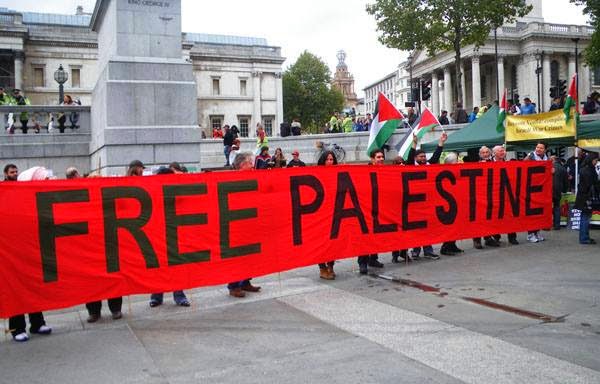
Free Palestine

Free Palestine

Sunday, February 19, 2012

US, Israel behind Iranophobia in Middle East


Iran's Ambassador to Beirut Ghazanfar Roknabadi says the US and the Israeli regime are behind the Iranophobia in the region in a bid to scare regional states from the country’s military might.

“The US and the Zionist regime [of Israel] are behind the Iranophobia in the region, but we (Iran) are trying to put an end to [these] anti-Iran rumors,” the Iranian official said Saturday with regards to the concern of some Arab states about Iran’s military might. 

He added that in response to any threat by the Zionist regime Iran is completely prepared. 

“Iran will not start a possible war with the Zionist regime but will deliver a decisive response to any aggression by the regime,” he added. 

This remarks come as earlier this month the Israeli Defense Minister Ehud Barak said if Western sanctions against Iran fail to stop its nuclear program, military action against the country must be placed on the agenda. 

The United States, Israel and their European allies accuse Tehran of pursuing military objectives in its nuclear program and used this pretext to sway the UN Security Council to impose four rounds of sanctions against the Islamic Republic. 

Washington and Tel Aviv have also threatened Tehran with the option of a military strike against its nuclear facilities. 

Tehran, however, refutes such allegations as baseless and maintains that as a signatory to the Nuclear Non-Proliferation Treaty and a member of the International Atomic Energy Agency (IAEA) it has every right to develop and acquire nuclear technology for peaceful purposes. 

Iranian officials have promised a crushing response to any military strike against the country, warning that any such measure could result in a war that would spread beyond the Middle East.

Britain is happy with DR Congo crises


A British writer has condemned the UK government for financing the mounting humanitarian crises in the Democratic Republic of Congo, where the civilians have remained the victims of mass killings, severe torture, and widespread rape.

The British government and media have turned a blind eye to the sever crisis taking place in the central African nation, because “the crisis in Congo is of no interest to UK government and media, and surprisingly they are happy with the violence occurring in the country,” Judith Ammanthis told Press TV in a phone interview.

She also criticized the media for imposing a news blackout on the latest protest of Congolese community in Britain who shouted against the silence of British government about Congo "corrupt election" results and crisis in the conflict-hit country.

“UK media and particularly BBC have effectively followed the interests of UK government, that is apparently pleased with the bloody conflicts of Congo,” she added.

President Joseph Kabila has been strongly supported by the western governments, as his People's Party for Reconstruction and Democracy was responsible for militarizing the mining industry, and continued to sell off the Congolese owned mining assets to western firms, specially to UK-based mining company, Eurasian Natural Resources Corporation, that has profited greatly from the situation in Congo.

As long as the British firms are exploiting the country’s oil and minerals including tin, tantalum, tungsten, Britain will ignore the humanitarian crisis such as child labor, slave labor, mass rape and the massacre of children, she also stressed.

“It’s quite scandalous that UK government has not addressed the Congo crises, but it is very transparent why this is happening, because it is of no interest to them whether people die or don’t die, they only consider UK’s financial interests in the region,” Ammanthis added.

Saturday, February 18, 2012

US, Israeli cyber attack on Press TV fails


A cyber attack by US and Israeli hackers against the website of Iran's English-language 24-hour news channel, Press TV, has failed to take down the website.

According to the Press TV report, the attack against the website took place on February 18, from 07:50 to 10:05 local time.

However, the effective security countermeasures taken by the Press TV technical team foiled the cyber attack on the website.

This is not the first cyber attack on Press TV. On December 9, 2011 American and Israeli hackers attacked the Press TV website after the network broadcast footage a of the US RQ-170 Sentinel stealth aircraft, an advanced US spy drone which was captured by the Iranian military for violating the country’s airspace.

The recent attack against Press TV website follows a January 19 attempt by British technicians operating from Bahrain to jam Islamic Republic of Iran Broadcasting channels on the Hotbird satellite, including Press TV.

The blocked channels included provincial channels and a number of international channels such as Press TV, Al-Alam, Al-Kowsar, Jam-e Jam and Sahar.

WHAT OIL SHOULD I BUY?

What oil should I buy
So what should I buy?

Quality Counts! It doesn't matter what sort of fancy marketing goes into an engine oil, or how many naked babes smear it all over their bodies, or how bright and colourful the packaging is, it's what's written on the packaging that counts. Specifications and approvals are everything. There are two established testing bodies. The API (American Petroleum Institute), and the European counterpart, the ACEA (Association des Constructeurs Europeens d'Automobiles - which was the CCMC). You've probably never heard of either of them, but their stamp of approval will be seen on the side of every reputable can of engine oil.

The API

The API classifications are different for petrol and diesel engines:
· For petrol, listings start with 'S' (meaning Service category, but you can also think of it as Spark-plug ignition), followed by another code to denote standard. 'SN' is the current top grade, which recently replaced 'SM' and 'SL'. 'SH' will be found on most expensive oils, and almost all the new synthetics. It's basically an upgraded 'SG' oil which has been tested more sternly.

· For diesel oils, the first letter is 'C' (meaning Commercial category, but you can also think of it as Compression ignition). 'CJ' is the highest grade at the moment, (technically CJ-4 for heavy-duty) but 'CH' is the most popular and is well adequate for passenger vehicle applications.


Note:
Castrol recently upgraded all their oils and for some reason, Castrol diesels now use the 'S' rating, thus completely negating my little aid-memoir above. So the older CC,CD,CE and CF ratings no longer exist, but have been replaced by an 'SH' grade diesel oil. This link is a service bulletin from Castrol themselves, explaining the situation.

The CCMC/ACEA

The ACEA standards are prefixed with a 'G' for petrol engines and a 'D' or 'PD' for diesel. Coupled with this are numerous approvals by car manufacturers which many oil containers sport with pride. ACEA replaced CCMC in 1996 primarily to allow for greater read-across in test programs (eg. for viscosity, viscosity modifiers and base oil). The CCMC specifications were G (1 to 5) for gasoline, D (1 to 5) or heavy duty diesel and PD1 and PD2 for passenger car diesel. ACEA though have a slightly different nomenclature they can be summarised as A for petrol, B for passenger car diesel and E for heavy duty diesel. The ACEA grades may also be followed by the year of issue which will be either '04 or '07 (current).


The full ACEA specs are:
· A1 Fuel Economy Petrol †

· A2 Standard performance level

· A3 High performance and / or extended drain

· A5 Fuel economy petrol with extended drain capability †

· B1 Fuel Economy diesel †

· B2 Standard performance level (now obsolete)

· B3 High performance and / or extended drain

· B4 For direct injection passenger car diesel engines

· B5 Fuel economy diesel with extended drain capability †

† Not suitable for all engines - should ONLY be used in engines specifying this fuel efficient grade. Refer to the manufacturer handbook of contact your local dealer if you're not sure.

Mineral oils:
· E1 Non-turbo charged light duty diesel

· E2 Standard performance level

· E3 High performance extended drain

· E5 (1999) High performance / long drain plus American/API performances. - This is ACEAs first attempt at a global spec.

· E7 Euro 4 engines - exhaust after treatment (EGR / SCR)

Part / full synthetic oils:
· E4 Higher performance and longer extended drain

· E6 Euro 4 specification - low SAPS for vehicles with PDF (see below)


Cross Conti Enterprises
Specialist In Fuel Additives and Lubricants .
Cell: +255 - 786 605248 / 2121496
Dar Es Salaam
Tanzania